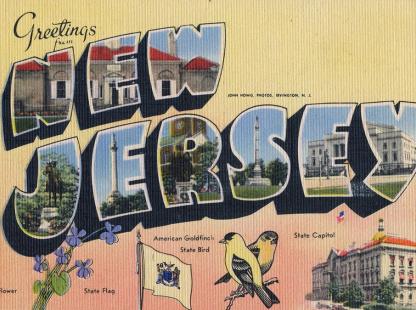
New Jersey Studies Initiative
The New Jersey Studies Initiative is an exciting cluster of courses that explore the history, culture, and social narratives of the Garden State through interdisciplinary perspectives drawn from the Humanities and Social Sciences. Across the collection, students investigate the state as both a geographic location and a cultural framework for understanding how local places, events, traditions, and media representations shape collective memory, cultural identity, and public discourse within New Jersey.
Professor: Professor Dan Loughran
This course examines the life, music, and cultural influence of Bruce Springsteen as a lens for understanding American identity, civic responsibility, and social justice. Through close engagement with song lyrics, performances, and public statements, students consider how his work reflects ongoing tensions between national ideals and lived realities.
The course situates Springsteen within broader traditions of American cultural expression, drawing connections to writers, poets, and thinkers who have shaped public conversations about community, agency, and moral accountability. Particular attention is given to recurring themes in his work, including labor, place, belonging, and the relationship between individual experience and collective life.
Course activities combine textual and media analysis with opportunities for applied and reflective work. Students connect the ideas explored in Springsteen’s music to contemporary social issues and to their own experiences, considering how artistic expression can inform civic engagement and personal responsibility. Projects emphasize critical interpretation, interdisciplinary inquiry, and the role of music and storytelling in shaping public understanding of American values.
Prerequisites: ENGL 102 (C or better), 200-Level History/Humanities GER.
Professor: Professor Ed Johnson
This course examines the evolution, structure, and future direction of political decision-making and public policy in the Garden State. Situating New Jersey within regional, national, and global contexts, it highlights the state’s distinctive political culture, complex governmental institutions, and ongoing fiscal challenges. Students consider how historical developments and contemporary forces shape governance in one of the nation’s most densely populated and economically diverse states.
The course provides a detailed overview of New Jersey’s system of state, county, and municipal government, with attention to the constitutional framework and the roles of the executive, legislative, and judicial branches. Particular focus is given to state-local relations and the practical implications of the state’s strong tradition of home rule. Fiscal foundations of policymaking—including tax structures, budgetary constraints, and long-term debt—are examined in relation to affordability and policy outcomes across the state.
Key policy areas—including transportation and infrastructure, education finance, land-use planning, and sustainable economic development—serve as focal points for understanding how competing priorities are negotiated and resolved. The course also addresses ethical governance, transparency, accountability, and the influence of campaign finance, lobbying, and interest groups.
Through case studies, policy analysis, and applied discussion, students develop the tools needed to interpret New Jersey’s political system and to evaluate how informed citizens and leaders can shape its future.
Prerequisites: ENGL 102 (C or better), 200-Level History/Humanities GER.
Professor: Professor Kenneth DeStefano
This course examines New Jersey’s wide-ranging influence on American popular culture, highlighting the state’s contributions across industries, media, and everyday life. From early industrial innovation to contemporary entertainment, New Jersey serves as a central site for understanding how regional culture shapes and is shaped by broader national trends.
Topics include the origins of iconic institutions such as diners, the state’s role in early American industry, and the cultural significance of places like Atlantic City. The course also considers New Jersey’s impact on music and performance with stars like Frank Sinatra and Bruce Springsteen, as well as the state's presence in film and television, including series such as The Sopranos and Jersey Shore.
Additional areas of focus include amusement and leisure culture, sports history, immigration and identity, folklore, and notable historical events. Through these examples, students consider how New Jersey functions as both a cultural crossroads and a source of widely recognized symbols, narratives, and experiences.
Coursework emphasizes analysis of media, historical materials, and cultural artifacts. Students investigate how familiar aspects of popular culture: how boardwalks, amusement parks, television, music, and everyday institutions reflect broader questions about identity, memory, and representation.
Prerequisites: ENGL 102 (C or better), 200-Level History/Humanities GER.
Professor: Kyle Mednick
This course explores the development of the true crime genre through notable cases connected to New Jersey. Using the state as a geographic and cultural framework, students analyze how crime stories are documented, interpreted, and retold across multiple forms of media, including journalism, literature, podcasts, documentary film, and television.
The class traces the evolution of crime narratives from early sensational reporting and penny-press journalism to contemporary long-form documentaries and serialized podcasts. Particular attention is paid to the narrative strategies that influence public understanding of crime and justice, as well as to the ethical questions surrounding the representation of victims, perpetrators, and communities.
Students work with historical records, literary texts, and media portrayals to consider the boundary between documented fact and narrative interpretation. Presentations and research projects centered on specific New Jersey cases highlight how crime stories enter cultural memory and how repeated retellings shape public perceptions of justice, responsibility, and history.
Prerequisites: ENGL 102 (C or better), 200-Level History/Humanities GER.
Professor: Miriam Ascarelli
This course is a journey into Newark’s rich and complicated history. Students will engage in a
semester-long research project where they will trace the history of a Newark site of their
choosing by using historical maps and other primary and secondary sources. Students will gain
the background they need for their project through readings, walking tours (all within a short
distance from campus) and class conversations with people who are helping to shape Newark’s
future.
Our exploration begins in the year 1666 when a group of Puritans from Connecticut purchased
the land that is now Newark from a group of Lenape Indians for a price that included four barrels
of beer, 10 pairs of breeches, two ankers of liquor, 10 kettles, 20 axes, 20 coats, 50 double hands
of powder, 100 bars of lead, 20 pistols, 10 swords, 40 blankets, 50 knives, 20 hoes, 850 fathoms
of wampum, and three troopers’ coats. From there, we will look at key issues that have impacted
the city, including the (little known) history of slavery in Newark (and New Jersey overall), how
rapid industrialization in the 19th century turned Newark into an industrial powerhouse, and how
the quest for racial equality as well as the closing of factories (and with it, the loss of jobs)
ushered in new challenges in the 20th century.
Prerequisites: Six credits of 300-level History/Humanities GER.
Professor: Crystal Hamai
This senior-level capstone seminar focuses on the folklore, legends, and unusual historical sites that have become part of New Jersey’s cultural landscape. Using case studies of regional stories and locations, students consider how communities make sense of places, events, and unexplained phenomena, and how certain sites come to be labeled “creepy,” haunted, or mysterious.
Drawing on perspectives from folklore studies, sociology, and cultural history, the course investigates what these narratives reveal about collective anxieties, historical memory, and changing attitudes toward death, spirituality, and the unknown. Topics include well-known regional legends such as the Jersey Devil and the Matawan shark attacks, as well as lesser-known stories, abandoned sites, and roadside attractions across the state.
Coursework centers on research and analysis of regional traditions and narrative forms. Students pursue a legend, site, or local phenomenon of their choosing through archival research, critical interpretation, or multimodal storytelling formats such as documentaries, podcasts, or video essays.
Prerequisites: Six credits of 300-level History/Humanities GER.
Professor: Dr. Risa Gorelick
This senior-level capstone seminar considers the cultural history and contemporary significance of the New Jersey shore as a distinctive regional space shaped by tourism, recreation, and community identity. Extending along the state’s Atlantic coastline, the shore encompasses a wide range of environments and experiences, from historic landmarks such as the Twin Lights to the music scene of Asbury Park, the boardwalk culture of seaside towns, and the resort landscapes of Atlantic City and Cape May.
Attention is devoted to how the shore has been imagined, experienced, and represented over time, with emphasis on its social traditions, local economies, and evolving meanings. Topics include seasonal tourism, regional foodways, entertainment and music cultures, and the boardwalk’s role as both a social gathering place and a symbolic space. Students also examine how environmental change, development, and preservation continue to shape shore communities.
Work in the course includes analysis of literature, film, television, and other media, alongside opportunities for independent exploration. Projects invite students to focus on particular towns, traditions, or themes—such as local histories, small businesses, environmental concerns, or regional folklore—linking personal interests to broader questions about place, memory, and representation.
Prerequisites: Six credits of 300-level History/Humanities GER.
This course is a comprehensive survey of Newark, a combined literature/cultural studies seminar
and anthropological field work course designed to explore and map Newark in various
disciplines, including literature, history, film, politics, religion, architecture, and sociology. It
will be provisional and investigative, based on knowledge accrued and acquired, delving into
various possible lines and intersections of inquiry. We will be cartographers of the cosmopolis,
generating new insights into the various meanings about cities and city life.
Since the inspiration and conception of this class originated in the work and life of Newark artist
Amiri Baraka (1934-2014)—in fact, was discussed and designed in tandem with him on the
campus of NJIT—the recurring and representative status of his legacy will be a cornerstone to
our site-strategic inquiry and sometimes a counterpoint or complement to other voices, other
vantages, other angles, and other core components of Newark’s artistic and cultural heritage
Meet the Instructors!
Ken DeStefano was born and raised in New Jersey, spending his formative years going diners for late night meals, concerts at Giants Stadium, and at places like Six Flags Great Adventure, Action Park, and the Jersey Shore. He was the least talented player on a high school basketball team that won its group sectional championship. He went to college in the hostile city of Boston where proudly proclaimed and displayed his New Jersey roots. He went to law school and has focused on labor law for almost 25 years, including 4 years as Director of Employee and Labor Relations at NJIT. He is currently an arbitrator, presiding over employee and labor disputes. He previously taught as an adjunct instructor at other institutions of higher education, and is the author of a novel which is set, in significant part, in the Asbury Park beach area in the late 1960’s.
It started with 4th of July fireworks — and ignited the historic rebuilding of Asbury Park. Through economic winters, hurricanes, and rampant corruption, Former Mayor Ed Johnson stepped forward to lead the city through revival, reform, and renewed hope. From City Hall to the State House, he confronted real crises, balanced power, and turned policy into progress.
Today, as Executive Director of Governmental Affairs and Community Relations at Brookdale Community College and Honorary Member of the Global Parliament of Mayors, Mr. Johnson connects local leadership to statewide influence and international engagement. His career spans New Jersey municipalities, Trenton’s political arena, and global civic networks - bringing politics out of textbooks and into real life.
In NJ Politics & Policy, students don’t just study how government works. They learn from someone who has run it. Expect candid stories, real-world strategy, and insider insight from a leader who has governed, negotiated, and represented New Jersey on both the local and global stage.
Daniel Loughran earned his doctorate from Rutgers University, with a concentration in Education, Culture, and Society. His thesis, Equity Work Takes Courage: A Case Study of an Elementary Principal’s Praxis, was grounded in textual concepts and political themes he had explored for nearly two decades in American high school English classrooms as well as in several presentations made at Bruce Springsteen and Syracuse University academic conferences. Loughran has published scholarly texts that speak to Springsteen’s social/cultural/historical impact, including Dialogic Praxis for a Runaway American Dream (2024); You Can Drive All Night and Never Make it Around: The Role of Belief in Personal and Collective Agency in Bruce Springsteen’s Oeuvre (2018); Asbury Park as Eutopia: “Eutopos” and “Outopos” (2006); and American Skin: Bruce Springsteen and the New Language of Moral Politics (2005). A lifelong educator, Loughran has served as the Assistant Superintendent for Curriculum & Instruction in the Franklin Township Public Schools in Somerset, New Jersey, since 2016.
Dr. Risa Gorelick has more than 30 years of experience in the field of Composition/Rhetoric. Her background as an educator can be characterized as a combination of collaborative-based and community-based work where her research has always impacted her teaching, administration, and service. Dr. Gorelick’s research focuses on Food Studies, Service-Learning, Writing Program Administration, and Labor Practices in Composition/Rhetoric and related fields. While not a New Jersey native, she has lived in Jersey (both Down the Shore and North Jersey) longer than anywhere else, and relishes in Jersey’s food, coastline, roadway exits, culture, cringey jokes, and history.
As a Senior University Lecturer in the Department of Humanities and Social Sciences at NJIT, Dr. Gorelick teaches Senior Seminars Food Narratives: Gumbo, Dumplings, Burgers, and More and the Down the Shore Everything’s Alright (the actual place, not the M-TV reality show), in addition to courses in Effective Communications, Technical/Work Place Writing, Advanced Writing, First-Year Writing, and Writing for Non-Native English Speakers. She served as Associate Coordinator of First-Year Writing from 2017-2020. She loves allowing students to explore their creative side and encouraging them to complete projects that show how they relate to the course material.
Additionally, she is a Senior Writing Coach at Defend, Publish, Lead, LLC where she assists people with their writing on dissertations, scholarly articles, books, job related materials, and other projects.
Since 1995, she has served as the Chair/Co-Chair of the Research Network Forum [RNF] of the Conference of College Composition and Communication [CCCC]. The RNF provides a platform for composition and rhetoric scholars to learn the latest research in the field and allow participants to share their current projects in small thematic roundtables at the annual convention. Through her work with RNF, Dr. Gorelick has mentored thousands of graduate students and junior faculty on their research and writing projects. Considered a luminary in her field, Cs the Day, which gamified the conference experience, added Dr. Gorelick to their deck of gaming cards.
Kyle Mednick is an adjunct professor at New Jersey Institute of Technology, where he advises Future Business Leaders of America and serves on the LGBTQIA+ History Month Committee. His scholarly interests include teacher mentorship and curriculum design. A lover of poetry, he incorporates it into his classes through the “Poem of the Day” (POD). He is also an avid theatre-goer who can often be found in one of Broadway’s historic theaters. Most importantly, he is passionate about supporting his students.
Jon Curley is a poet, professor, and critic originally from New England. He has a particular passion for Newark's art and culture. Curley is also avidly interested in building creative community engagement on and off campus.