HSS Special Topics
As part of its ongoing efforts to bring students resonant and engaging courses for students, the Humanities and Social Sciences Department runs a wide selection of Special Topics courses to trial new classes for students. Each section of a special topics course number focuses on a different topic across an array of interests.
Each course requires students to have completed their 200-level HIST/HUM GER, and will count towards student's 300-level HIST/HUM GER. (Restrictions by degree may apply)
Explore some of these topics below:
COM 325: Special Topics in Communications and Media
Professor: Michael Laudenbach
Professor: Michael Worden
Professor: William Kramer
Professor: Joshua Tobiessen
Professor: Rebekah Rutkoff
Meet the Instructors!
LIT 325: Special Topics in Literature
Professor: Kyle Mednick
This course explores the development of the true crime genre through notable cases connected to New Jersey. Using the state as a geographic and cultural framework, students analyze how crime stories are documented, interpreted, and retold across multiple forms of media, including journalism, literature, podcasts, documentary film, and television.
The class traces the evolution of crime narratives from early sensational reporting and penny-press journalism to contemporary long-form documentaries and serialized podcasts. Particular attention is paid to the narrative strategies that influence public understanding of crime and justice, as well as to the ethical questions surrounding the representation of victims, perpetrators, and communities.
Students work with historical records, literary texts, and media portrayals to consider the boundary between documented fact and narrative interpretation. Presentations and research projects centered on specific New Jersey cases highlight how crime stories enter cultural memory and how repeated retellings shape public perceptions of justice, responsibility, and history.
Professor: Maria DiLorenzo
Professor: Maria DiLorenzo
Meet the Instructors!
PSY 325: Special Topics in Psychology
Professor: Kelly Connover
This course examines the normative development of children from conception through adolescence, fostering an understanding of the psychological nature of the child. Research, theoretical frameworks, and current events will be integrated to support course topics. Areas of focus include physical, cognitive, moral, social, and emotional development; factors influencing developmental trajectories; and approaches to child and adolescent treatment and therapy.
The purpose of this course is to provide students with a comprehensive understanding of the psychological principles underlying child development. This course is designed to be a collaborative learning process by which students will engage in class discussions, group work, and assignments. The primary goal of this course is to encourage and support students as they develop an understanding of the material discussed in class and how it can be applied to the real world. At the conclusion of this course, students should be able to: 1) Identify and compare major theories of child development; 2) Describe developmental milestones across infancy, childhood and adolescence; 3) Be able to think critically about developmental theories and concepts and how they apply to social and cultural norms; 4) Identify influences on child development; 5) Apply knowledge of theories and other concepts to topics such as parenting, education and mental health; and 6) Understand basic mental health issues affecting children and adolescence and therapeutic treatment modalities.
Professor: Neel Khichi
Professor: Abriana Gresham
Professor: Brain Oland
This course provides an in-depth, interdisciplinary exploration of human sexuality, examining the complex interplay of biological, psychological, and sociocultural influences. Students will study the structure and function of sexual anatomy and reproductive systems, as well as the hormonal and physiological processes that shape sexual development and behavior. The course will also introduce major theories of psychosexual development and consider how these frameworks help explain human sexual expression across the lifespan.
In addition, students will explore the diversity of sexuality across cultures, with attention to how social norms, values, and historical contexts influence attitudes and behaviors related to sex and intimacy. Key topics include gender identity, gender roles, and gender diversity, with an emphasis on inclusivity and the experiences of gender-variant individuals. The course will further examine sexual health and well-being, including common sexual concerns and dysfunctions, as well as the dynamics of healthy and unhealthy relationships.
Legal, ethical, and social issues surrounding sexuality will also be addressed, encouraging students to think critically about consent, rights, and responsibilities in both personal and societal contexts. Through discussion, reflection, and analysis, students will develop a well-rounded understanding of human sexuality and its role in individual lives and broader communities.
Professor: Kaitlin Cohen
Meet the Instructors!
STS 325: Special Topics in Science, Technology, and Society
Professor: Zackary Kellett
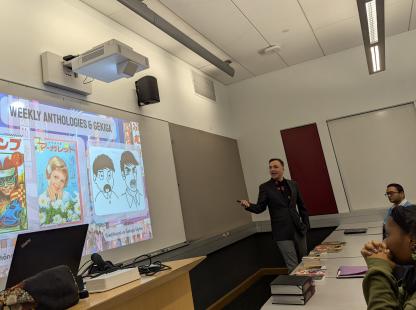
This course explores the interwoven cultural and industrial landscape of Japan's "Media Mix." Using Japanese Anime as a focal point, students will examine the history of Japanese popular media and the increasing impact of professionals and fans within "Otaku" culture globally, as well as locate these mediums as part of wider national efforts such as "Cool Japan" to expand Japanese soft power abroad.
This course will cover the historical origins and influences of traditional Japanese art forms including Noh, Kabuki, Bunraku, Ukiyo-e, Rakugo, Manzai, and Kamishibai on contemporary Manga and Anime storytelling, as well as how professional localization and fan remixing reinterpret and propagate aspects of Japanese culture around the world.
Students will also examine contemporary Japanese popular culture as part of a wider cultural and economic ecosystem. Topics will include ties between the animation and music industries, idol culture, mascots and the "anime-esque," and the process of adapting intellectual properties across mediums.
Titles that will be examined as part of the course will include Akira, Astro Boy, Cowboy Bebop, Dragon Ball, Demon Slayer, Jujutsu Kaisen, One Piece, Pokémon, Sailor Moon, and more. Through a mix of media analysis and research, students will gain critical analytical skills in transmedia contexts, and gain a deeper understanding of globalized media.
Professor: Chia-Ying Shih
Through exploring East Asian popular culture in Japan, South Korea, China, Hong Kong, and Taiwan, this course critically examines globalization, soft power, and cultural transmission in the age of AI and digital platforms.
The course covers diverse media forms, K-pop, Chinese video games, Japanese anime, and short-form videos such as TikTok, Instagram Reels, and YouTube Shorts.
It also investigates how AI and algorithms are reshaping content creation, distribution, and fan engagement, revealing the new ecosystem of contemporary cultural industries.
In class, students will observe and discuss how Japan, South Korea, China, Hong Kong, and Taiwan strategically "sell" their culture. They will consider how cultural, industrial, and political forces shape regional and global media flows. Students will critically analyze how diverse cultural forms are produced, consumed, and adapted both within and beyond East Asia. They will also examine how media technologies and creative trends, such as fan remixes, AI-generated imagery, and moving videos from YouTube Shorts to TikTok and then to Instagram Reels, transform industry operations and market dynamics.
Professor: Ed Johnson
This course examines the evolution, structure, and future direction of political decision-making and public policy in the Garden State. Situating New Jersey within regional, national, and global contexts, it highlights the state’s distinctive political culture, complex governmental institutions, and ongoing fiscal challenges. Students consider how historical developments and contemporary forces shape governance in one of the nation’s most densely populated and economically diverse states.
The course provides a detailed overview of New Jersey’s system of state, county, and municipal government, with attention to the constitutional framework and the roles of the executive, legislative, and judicial branches. Particular focus is given to state-local relations and the practical implications of the state’s strong tradition of home rule. Fiscal foundations of policymaking—including tax structures, budgetary constraints, and long-term debt—are examined in relation to affordability and policy outcomes across the state.
Key policy areas—including transportation and infrastructure, education finance, land-use planning, and sustainable economic development—serve as focal points for understanding how competing priorities are negotiated and resolved. The course also addresses ethical governance, transparency, accountability, and the influence of campaign finance, lobbying, and interest groups.
Through case studies, policy analysis, and applied discussion, students develop the tools needed to interpret New Jersey’s political system and to evaluate how informed citizens and leaders can shape its future.
Professor: Jim Fraser
Professor: Emily Tancredi-Brice Agbenyega
This course is only open for registration to students part of the Albert Dorman Honor's College
Professor: Dan Loughran
This course examines the life, music, and cultural influence of Bruce Springsteen as a lens for understanding American identity, civic responsibility, and social justice. Through close engagement with song lyrics, performances, and public statements, students consider how his work reflects ongoing tensions between national ideals and lived realities.
The course situates Springsteen within broader traditions of American cultural expression, drawing connections to writers, poets, and thinkers who have shaped public conversations about community, agency, and moral accountability. Particular attention is given to recurring themes in his work, including labor, place, belonging, and the relationship between individual experience and collective life.
Course activities combine textual and media analysis with opportunities for applied and reflective work. Students connect the ideas explored in Springsteen’s music to contemporary social issues and to their own experiences, considering how artistic expression can inform civic engagement and personal responsibility. Projects emphasize critical interpretation, interdisciplinary inquiry, and the role of music and storytelling in shaping public understanding of American values.